Square Trinket Dish STL File - Digital D
In the realm of digital fabrication, the transition from a concept to a tangible object is often defined by the quality of the source file. The Square Trinket Dish STL File - Digital D represents a strategic asset for creators who require precise, minimalistic storage solutions without the overhead of custom tooling or expensive manufacturing runs. This digital download provides five distinct variations of a square container, designed specifically for additive manufacturing workflows. Whether you are integrating this into a personal organization system, scaling it for a small business product line, or using it as a base for artistic resin projects, the file serves as a foundational component in your production pipeline.
The utility of this design extends beyond simple storage; it functions as a versatile module within a broader organizational ecosystem. For professionals and hobbyists alike, the ability to generate physical assets on demand allows for rapid iteration and customization. Unlike traditional inventory management, which relies on fixed SKUs and shipping logistics, utilizing a digital file like Square Trinket Dish STL File - Digital D empowers you to control the entire lifecycle of the product—from the initial slicing process to the final post-processing stage. This level of autonomy is particularly valuable for entrepreneurs looking to test market viability with low-risk prototypes or educators needing durable teaching aids.
Strategic Integration into Creative and Business Workflows
Understanding where the Square Trinket Dish STL File - Digital D fits into your daily operations requires a shift in perspective. It is not merely a file to be downloaded; it is a resource that interacts with your existing hardware, material choices, and aesthetic goals. The design's minimalist geometry makes it an ideal candidate for various stages of a project lifecycle. In the planning phase, these files can be used to visualize spatial requirements for desk setups or retail displays. During execution, they serve as the blueprint for creating functional tools that enhance productivity.
For those engaged in content creation or blogging, having access to high-quality, printable assets can streamline the creation of visual materials. Imagine producing a series of videos demonstrating organization hacks or crafting tutorials; the ability to 3D print unique props instantly eliminates the need to purchase generic items. Similarly, for freelancers and small business owners, this file offers a pathway to diversify revenue streams. By printing these dishes and selling them as physical goods, you leverage the scalability of digital distribution while maintaining the tactile value of a handmade product.
Material Compatibility and Process Optimization
The successful implementation of the Square Trinket Dish STL File - Digital D hinges on selecting the right materials and optimizing your printer settings. The design is engineered for ease of printing, but achieving professional-grade results requires attention to detail regarding filament choice and layer configuration. Standard PLA is a reliable starting point for general use, offering durability and ease of handling. However, if your goal involves infusing the dish with resin for decorative purposes, the printing parameters must be adjusted accordingly.
When preparing to create resin-infused trinket dishes, a thicker top layer is essential. This structural reinforcement ensures that the resin does not penetrate the bottom layers of the print, which could compromise the integrity of the piece or cause warping. Furthermore, compatibility between the filament and the pigment is a critical factor. Certain filaments have a chemical affinity for alcohol inks and other pigments, potentially causing color bleeding or unintended textural changes. Before committing to a full batch of prints, conducting a small-scale test run allows you to verify how specific materials react with your chosen additives. This step is vital for maintaining consistency and quality control across multiple units.
- Preparation: Ensure your printer bed is leveled and the nozzle is clean to prevent adhesion issues that could ruin the first few millimeters of the print.
- Filament Selection: Choose filaments based on the intended finish; matte finishes work well for modern aesthetics, while glossy filaments can enhance the appearance of resin infills.
- Post-Processing: Plan for sanding or sealing steps if you intend to apply liquid resins, as surface smoothness directly impacts the final visual outcome.
Scalability Through Multiple Size Variations
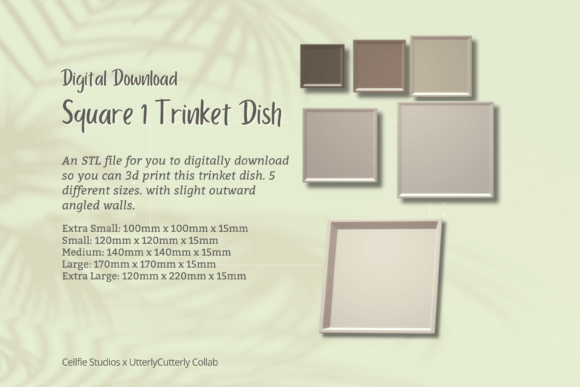
One of the most significant advantages of this digital package is the inclusion of five distinct sizes, allowing for flexible deployment across different environments. The range spans from the Extra Small variant at 100mm x 100mm x 15mm to the Extra Large option measuring 120mm x 220mm x 15mm. This variety supports a tiered approach to organization, enabling users to create cohesive sets that fit specific spatial constraints.
In a home office setting, the smaller sizes (Extra Small and Small) are perfect for organizing loose change, paperclips, or USB drives on a cluttered desk. The Medium and Large options can serve as central hubs for larger items such as keys, wallets, or even plant cuttings in a living area. The Extra Large size, with its elongated footprint, is particularly useful for bathroom counters or entryway tables where space is abundant but organization is needed. By having all five sizes available in a single download, you eliminate the need to search for multiple designs, ensuring a consistent aesthetic throughout your environment.
For businesses, this scalability translates directly into product differentiation. A boutique owner could offer a "Desk Organizer Set" containing one of each size, marketed as a complete solution for workspace efficiency. Alternatively, a maker could sell individual units tailored to specific customer needs, reducing waste and maximizing profit margins. The uniform wall thickness of 15mm across all sizes ensures that the structural integrity remains consistent, regardless of the dimensions, making the design robust enough for heavy-duty use.
Workflow Considerations for Production
Integrating the Square Trinket Dish STL File - Digital D into a production workflow requires careful planning to maximize efficiency. When preparing to print multiple units, consider the orientation of the parts on the build plate. While the square shape is generally stable, arranging the pieces to minimize support structures can significantly reduce print time and post-processing effort. For high-volume runs, batching the files by size can help optimize slicer settings, ensuring that each group is printed with the optimal layer height and infill density.
It is also important to manage expectations regarding the digital nature of the product. As a digital download, the Square Trinket Dish STL File - Digital D provides immediate access to the design files, bypassing shipping delays and inventory costs. However, the responsibility for the physical output lies with the user. This means that factors such as printer calibration, environmental conditions, and material availability become part of the equation. Successful implementation involves acknowledging these variables and establishing a routine for maintenance and testing. Regularly checking your printer's extruder and cleaning the nozzles will ensure that every print matches the precision of the original design.
Furthermore, the versatility of the design encourages experimentation. Users can mix and match colors, textures, and finishes to create unique variations that stand out in a crowded market. The simplicity of the square form acts as a canvas, allowing the material properties to take center stage. Whether you are aiming for a sleek, monochromatic look or a vibrant, multi-colored display, the underlying structure remains adaptable. This adaptability is key to long-term relevance, as trends in interior design and consumer preferences evolve over time.
Long-Term Value and Sustainability
Beyond the immediate benefits of convenience and cost savings, adopting a digital-first approach to manufacturing aligns with sustainable practices. By printing only what is needed, when it is needed, you reduce the carbon footprint associated with mass production and global shipping. The Square Trinket Dish STL File - Digital D facilitates this model by providing a reusable asset that can be accessed indefinitely. There is no risk of obsolescence, as the file can be reprinted years later with identical specifications.
This longevity is particularly appealing to educators and community organizers who frequently need durable, customizable tools. Instead of purchasing disposable plastic organizers that wear out quickly, printing a set of trinket dishes from high-quality filament creates a lasting solution. The modular nature of the design also allows for easy replacement of individual components without discarding the entire set. If a dish becomes damaged, you can simply reprint that specific size, extending the lifespan of your collection.
Ultimately, the Square Trinket Dish STL File - Digital D is more than just a template for a container; it is a tool for empowerment. It bridges the gap between digital creativity and physical reality, offering a practical solution for a wide array of users. From the freelancer organizing their workspace to the entrepreneur launching a new product line, the ability to produce high-quality, customized items on demand is a powerful advantage. By understanding the nuances of material selection, printer optimization, and workflow integration, you can fully leverage the potential of this design to achieve your personal and professional goals.