Happy Birthday Cake Topper 3: Integrating Digital Assets into Your Creative Workflow
In the modern landscape of digital creation and home manufacturing, the boundary between a simple consumer product and a professional asset has blurred significantly. The Happy Birthday Cake Topper 3 represents more than just a decorative element for a celebration; it is a prime example of how digital downloads can be seamlessly integrated into personal projects, small business operations, and creative workflows. This specific design serves as a functional component within a broader process of event planning, content creation, or entrepreneurial venture.
Unlike traditional retail items that require shipping logistics and inventory management, this product exists purely in the digital realm. It is a digital download containing an STL file, which acts as the blueprint for physical production. For professionals, hobbyists, and entrepreneurs aged 20 to 50, understanding the lifecycle of such a file—from acquisition to slicing, printing, and final assembly—is crucial for maximizing efficiency and quality. This article explores how to incorporate the Happy Birthday Cake Topper 3 into your daily routines and business models without unnecessary friction.
Defining the Asset and Its Role in Production
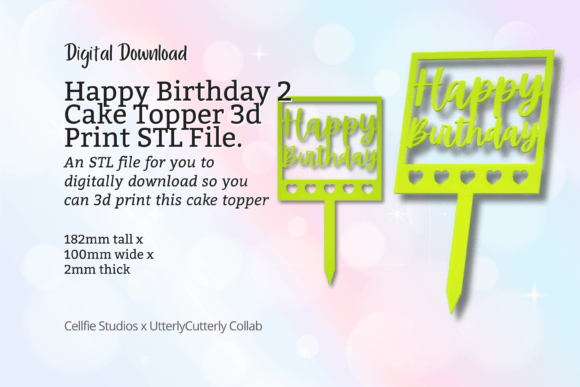
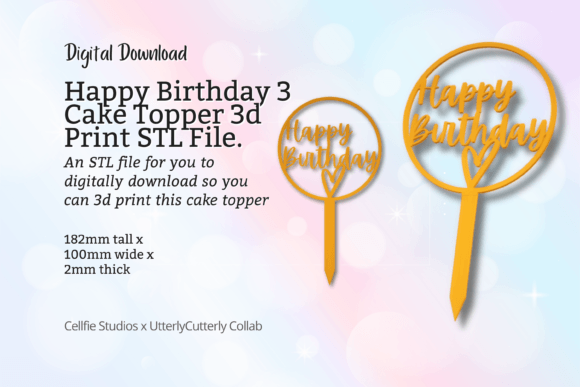
The Happy Birthday Cake Topper 3 is a 3D printable model designed with precision dimensions of 100mm x 182mm x 2mm. These measurements are not arbitrary; they dictate how the object fits onto standard cake sizes and ensures structural integrity during transport and display. As a digital asset, it functions as a reusable resource. Once purchased, you own the rights to generate infinite copies, provided you adhere to the license terms associated with the purchase.
This distinction is vital for workflow planning. When you acquire a physical topper from a store, your involvement ends at the point of sale. With the STL file version, you become the manufacturer. This shift requires a different mindset focused on preparation, machine calibration, and quality control. The file is part of a larger ecosystem of 3D printing resources, where new designs are released weekly, offering a steady stream of fresh content for creators looking to expand their offerings or enhance their personal events.
Preparation and Compatibility Checks
Before initiating any print job involving the Happy Birthday Cake Topter 3, the first step in the workflow is verifying compatibility with your existing hardware and software stack. While the file is tested before being sold as part of our standard quality-checking system, the environment in which you print plays a significant role in the final outcome. You must assess whether your 3D printer's build volume accommodates the 182mm height of the topper.
Furthermore, the success of the print depends heavily on your slicer settings. The recommended configuration utilizes a 0.4mm nozzle at a print speed of 150 mm/sec. However, these are baseline parameters. In a professional setting, one should never assume default settings apply universally. Factors such as filament type (PLA, PETG, etc.), ambient temperature, and printer bed adhesion capabilities will necessitate adjustments. Amending your own settings based on your specific machine's performance history is a necessary step to ensure consistency and avoid print failures.
Implementation Strategies for Different User Groups
The versatility of the Happy Birthday Cake Topper 3 allows it to serve various purposes depending on the user's goals. Whether you are organizing a family milestone, running a side hustle selling handmade goods, or creating content for social media, the integration process varies slightly but follows similar principles of execution.
- For Event Planners and Home Organizers: If you are managing a birthday celebration, this digital asset eliminates the need for last-minute shopping trips. By downloading the file beforehand, you can schedule the print job days in advance, ensuring the topper is ready when the cake is prepared. This approach reduces stress and allows for customization, such as changing colors to match a specific theme palette.
- For Small Business Owners and Sellers: Entrepreneurs can leverage this file to create a revenue stream. By purchasing the STL file, you gain the ability to sell physical prints of the topper. This transforms a low-cost digital investment into a scalable product line. The key here is efficiency; once the profile is set up, you can batch print multiple units, packaging them for immediate shipment or local pickup.
- For Content Creators and Marketers: Influencers and bloggers often require high-quality props for their visual content. A custom-printed topper offers a unique aesthetic that stock photos cannot replicate. Using the Happy Birthday Cake Topper 3 allows you to produce authentic, branded imagery that resonates with your audience, enhancing the perceived value of your content.
Quality Control and Consistency
In any production workflow, maintaining quality standards is non-negotiable. Since this is a digital-only product, there is no physical item to inspect upon delivery. Instead, the quality check happens during the printing phase. The design features thin walls (2mm), which demand careful attention to layer adhesion and infill density. If you are producing items for commercial sale, implementing a rigorous inspection protocol is essential. Each printed unit should be examined for warping, stringing, or layer shifting before it reaches the customer.
Consistency is also a factor in long-term use. If you plan to sell these toppers regularly, documenting your successful settings creates a valuable knowledge base. Saving your specific slicer profiles ensures that every subsequent print matches the previous ones, building trust with your customers. This systematic approach separates casual experimentation from professional output.
Understanding the Transactional Nature of Digital Goods
A critical aspect of integrating this product into your routine is understanding the nature of the transaction. The Happy Birthday Cake Topper 3 is strictly a digital file. Nothing will be shipped to you, and the delivery method is instant access via email or a download link immediately following payment. This immediacy aligns perfectly with agile workflows where time is of the essence.
However, this digital nature also dictates the return policy. Because the product is intangible and can be copied infinitely, returns are generally not accepted. This policy protects the intellectual property of the creator while placing the responsibility of due diligence on the buyer. Before completing the purchase, users should verify their printer capabilities and ensure they have the necessary software installed. This pre-purchase verification step is a best practice for anyone dealing with digital assets.
Integration with Broader Creative Ecosystems
The Happy Birthday Cake Topper 3 does not exist in isolation. It interacts with other tools in the 3D printing ecosystem. For instance, it may be paired with other STL files to create a complete party decoration suite. Users might combine this topper with matching cupcake toppers or themed table decorations, all printed using the same settings and materials. This modular approach enhances the overall aesthetic impact of a project.
Moreover, the availability of new STL files every week suggests a dynamic marketplace. Staying updated with these releases allows users to keep their offerings fresh. For a business owner, this means continuously refreshing the catalog without needing to hire a designer for every new variation. For a hobbyist, it provides endless opportunities for learning and experimentation with different geometries and structures.
Optimizing the Printing Process
To achieve the best results with the Happy Birthday Cake Topper 3, optimizing the printing process is key. The recommended print speed of 150 mm/sec is relatively fast, which is efficient for productivity but requires a stable machine. Slower speeds might improve surface finish, especially if the topper will be displayed under bright lighting where imperfections are more visible.
Orientation matters as well. Positioning the topper correctly on the build plate can minimize support material usage, reducing post-processing time. Since the design is 182mm tall, printing it upright might require a large build volume. If space is limited, consider rotating the model, though this may affect the structural strength of the vertical elements. Testing a single print before committing to a full batch is a prudent strategy to validate orientation and settings.
Conclusion on Practical Application
The Happy Birthday Cake Topper 3 exemplifies the power of digital-to-physical workflows. It offers a flexible solution for those who want to add a touch of extravagance to celebrations or those looking to capitalize on the growing market for 3D printed goods. By treating the STL file as a core component of a production pipeline rather than a static image, users can unlock significant value.
Success with this asset relies on preparation, technical understanding, and adherence to quality standards. Whether used for a personal milestone or a commercial enterprise, the ability to control the entire manufacturing process from a digital file empowers the user. With proper settings, consistent quality checks, and strategic planning, the Happy Birthday Cake Topper 3 becomes a reliable tool in your creative arsenal, ready to elevate any occasion or business venture.