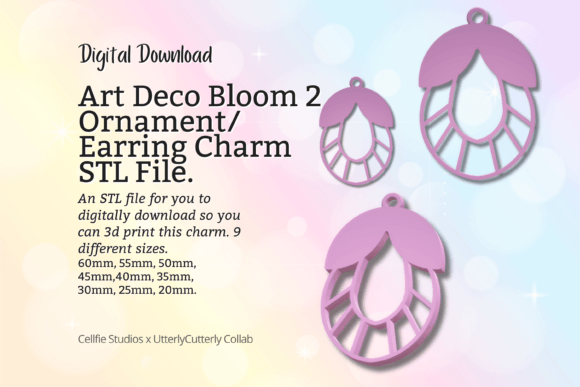
Art Deco Bloom 1 Earring Charm STL File
The digital asset market for 3D printing has matured significantly, shifting from novelty novelty items to sophisticated tools for professional creators and serious hobbyists. Among the most versatile categories in this space are jewelry and accessory files, which require a high degree of precision, aesthetic balance, and structural integrity. The Art Deco Bloom 1 Earring Charm STL File represents a compelling entry in this category, offering a blend of vintage-inspired geometry and modern manufacturing capabilities. For designers, small business owners, and makers looking to expand their product lines or personal collections, understanding the practical value of such a file is essential before committing to production.
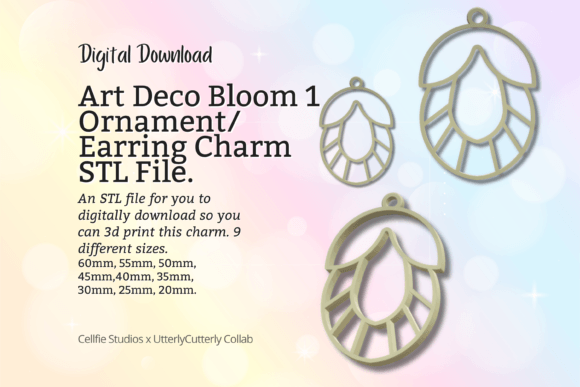
This resource is not merely a single image but a comprehensive pack containing nine distinct sizes of the same design. This multi-size approach addresses a critical need in the 3D printing workflow: scalability. Whether the goal is to create delicate earrings, statement necklaces, keyring charms, or even larger decorative pieces like wall hangings or Christmas ornaments, having a range of dimensions ensures that the design can be adapted to various material constraints and functional requirements without requiring complex re-modeling. The file is provided as a digital download, meaning it is intended for immediate use with compatible 3D printers and slicing software.
Design Aesthetics and Structural Versatility
The core appeal of the Art Deco Bloom 1 lies in its geometric purity and historical resonance. Art Deco style is characterized by bold lines, symmetrical patterns, and a sense of luxury, all of which translate well into additive manufacturing. The "Bloom" aspect suggests an organic motif—likely floral or radial—that is constrained within the rigid, elegant framework typical of the 1920s and 30s. This juxtaposition creates a piece that feels both timeless and contemporary.
From a technical standpoint, the design’s strength lies in its adaptability. The inclusion of nine specific sizes allows for precise control over scale. The dimensions provided range from 20mm up to 60mm. It is important to note that these measurements do not include any additional loop holes or attachment points. This is a crucial detail for users who plan to add findings, jump rings, or chains. By keeping the base design free of pre-integrated hardware, the file remains flexible. Users can choose to print the charm as a standalone pendant, drill a hole for wire wrapping, or integrate custom-designed loops depending on their preferred finishing techniques.
- 60mm: Ideal for large statement pieces, such as maxi earrings, heavy pendants, or small decorative wall art.
- 55mm - 45mm: Suitable for medium-sized accessories, including standard drop earrings, brooches, or bag charms.
- 40mm - 30mm: Perfect for everyday wearables like stud earrings, necklace drops, or keyring attachments.
- 25mm - 20mm: Best for intricate details, micro-charms, or components where fine resolution is prioritized over bulk.
Quality Assurance and Print Readiness
In the realm of digital downloads, quality inconsistency is a common pain point. Files may contain non-manifold geometry, inverted normals, or excessive polygon counts that cause slicing errors or print failures. The provider of the Art Deco Bloom 1 STL File emphasizes a standard quality-checking system where all products are tested before sale. While no digital file can guarantee success across every possible hardware configuration, this testing phase significantly reduces the risk of encountering corrupted data.
However, users must recognize that 3D printing is not a plug-and-play process in the traditional sense. Even with a perfectly modeled STL file, the final output depends heavily on printer calibration, slicer settings, and material choice. The documentation accompanying such files often provides baseline settings, but these should be treated as starting points rather than absolute rules. Different slicers (such as Cura, PrusaSlicer, or Simplify3D) interpret geometry differently, and various printers (FDM vs. SLA/DLP) have distinct resolution limits.
For FDM (Fused Deposition Modeling) printers, layer height and infill density will impact the surface finish. A finer layer height (e.g., 0.1mm) will better capture the intricate details of the Art Deco pattern, while a coarser setting may result in visible stair-stepping effects on curved surfaces. For resin (SLA/DLP) printers, the focus shifts to exposure times and support structures. Given the likely thin walls and delicate features of a bloom design, adequate support placement is vital to prevent collapse during printing.
Practical Applications and Market Potential
The versatility of the Art Deco Bloom 1 makes it suitable for a wide array of applications. For individual creators, it offers a low-barrier entry into jewelry making. Unlike casting metal, which requires specialized equipment and safety precautions, 3D printing allows for rapid prototyping and iteration. A maker can print a sample in PLA to check fit and aesthetics, then move to more durable materials like PETG, ABS, or resin for the final product.
For entrepreneurs and small business owners, this file presents a viable opportunity for inventory diversification. The ability to produce multiple sizes from a single design source reduces the overhead associated with managing separate SKUs for different dimensions. Furthermore, the aesthetic appeal of Art Deco designs tends to have broad market acceptance, appealing to consumers who appreciate classic elegance with a modern twist. These items can be sold as finished goods, painted and polished, or used as components in mixed-media jewelry.
Educators and workshop leaders may also find value in this file. Its clean geometry makes it an excellent subject for teaching students about scaling, tolerance, and post-processing techniques. The fact that it ranges from small to medium sizes allows instructors to demonstrate how changes in scale affect structural integrity and visual impact.
Considerations for Buyers and Makers
While the Art Deco Bloom 1 STL File offers significant advantages, potential users should be aware of certain limitations. First, the file is a digital product only. No physical item will be shipped. This is standard practice for digital asset stores, but it is worth reiterating to avoid confusion. Second, the absence of pre-made loop holes means that users must either design their own attachment mechanisms or modify the STL using CAD software if they require specific integration points. This adds a step to the workflow but preserves the flexibility of the original design.
Material selection is another critical factor. Standard PLA is easy to print and biodegradable, making it great for prototypes and indoor decorations. However, for jewelry intended for regular wear, materials with higher durability and heat resistance, such as PETG or ABS, are preferable. Resin prints offer the highest level of detail and smoothness but may require UV curing and washing stations, adding to the initial setup cost for home users.
Additionally, users should consider the aesthetic finish. 3D printed parts often have visible layer lines, especially in FDM printing. To achieve a professional look akin to cast metal or polished plastic, post-processing steps such as sanding, priming, and painting are necessary. Alternatively, using translucent resin and polishing can mimic glass or crystal, leveraging the geometric transparency of the design.
Conclusion
The Art Deco Bloom 1 Earring Charm STL File is a well-structured, versatile digital asset that caters to the needs of modern 3D printing enthusiasts and professionals. Its multi-size pack format solves the common problem of scalability, allowing users to tailor the design to specific projects without needing to source multiple files. The emphasis on quality testing provides a layer of confidence, though users must still apply their own expertise regarding slicer settings and printer maintenance.
For those looking to create unique, vintage-inspired accessories or expand their digital inventory, this file offers a solid foundation. Its clean design, combined with the flexibility of 3D printing technology, enables a level of customization and efficiency that traditional manufacturing methods cannot easily match. By understanding the technical requirements and post-processing needs, users can transform this digital file into tangible, high-quality objects that resonate with both personal taste and market demand.